

In an increasingly competitive IT hiring landscape, companies can no longer rely solely on theoretical knowledge assessments. Candidates may master concepts, pass technical interviews, and present strong CVs without necessarily being effective in real-world environments.
This is why the key challenge today is evaluating IT engineers’ production readiness, that is their ability to solve real problems, work under constraints, and deliver effectively in production-like conditions.
Table of Conetnts
1. What Is Operational Readiness in IT Hiring?
2. Why Evaluating Operational Readiness Is Essential
3. Limitations of Traditional Technical Interviews
4. Signals of a Production-Ready IT Engineer
5. Real-World Assessment Methods
6. Building a Reliable IT Hiring Process
7. Toward More Concrete and Measurable IT Evaluation
1. What Is Operational Readiness in IT Hiring?
Operational readiness in IT hiring refers to a candidate’s ability to solve real-world problems, work under constraints, and deliver effectively in production-like environments.
Skills assessed:
- technical problem-solving ability
- production incident management
- fast and effective decision-making
- adaptability to real-world environments
- ability to prioritize tasks under pressure
This concept focuses on how well an IT engineer can perform in real operational conditions, not just in theoretical or interview settings.
2. Why Evaluating Operational Readiness Is Essential
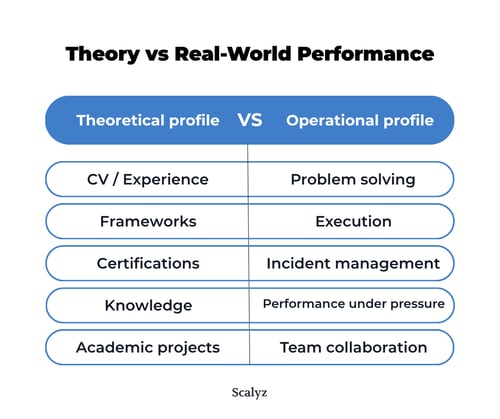
In modern IT projects, the gap between a candidate who looks strong on paper and one who performs effectively in production is often significant.
A candidate may:
- master frameworks and technical tools
- pass coding or technical interviews
- have strong theoretical experience
without being able to deliver in real-world production environments.
This is why companies must now focus on real-world performance and operational capability, rather than relying only on declarative knowledge or interview-based assessments.
3. Limitations of Traditional Technical Interviews
Traditional technical interviews are often based on:
- theoretical questions
- discussions about past projects
- isolated coding exercises disconnected from real production environments
The main issue is that they fail to evaluate:
- incident management in production systems
- decision-making under pressure
- real-world problem-solving ability
To go deeper on this topic, you can also read our article “The Hidden Limitations of Traditional Technical Tests”, which highlights the common biases and blind spots in conventional technical assessment methods.
4. Signals of a Production-Ready IT Engineer
A truly operational IT engineer is not defined only by knowledge, but by how they work in real situations.
Key indicators:
- quickly structures their reasoning approach
- effectively prioritizes tasks under constraints
- tests and iterates on solutions
- validates assumptions with data or system feedback
- adapts to technical and operational constraints
These signals are most visible in real-world scenarios and production-like environments, and are rarely fully observable in traditional technical interviews.
5. Real-World Assessment Methods
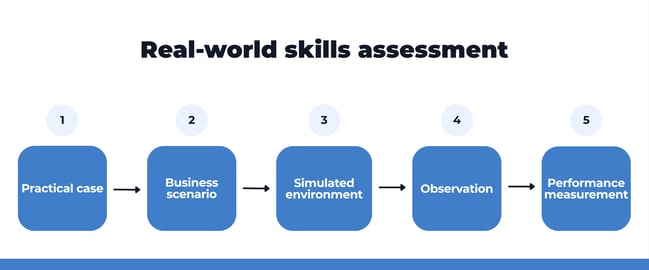
Practical case studies and business scenarios
Assessments should closely reflect real engineering work, such as:
- technical problem-solving tasks
- IT incident management scenarios
- critical bug fixing exercises
Simulated environments
Immersive testing environments help to:
- replicate real production situations
- observe actual candidate behavior
- measure performance under realistic constraints
Solutions like Scalyz enable companies to simulate production-like environments with realistic, scenario-based evaluations.
Concrete example
“A candidate may pass a technical test but fail when facing a critical production incident.”
This clearly illustrates why theoretical knowledge alone is not sufficient to evaluate true operational readiness.
6. Building a Reliable IT Hiring Process
To improve IT recruitment quality, it is essential to structure your hiring approach:
- include real-world simulations early in the hiring process
- standardize evaluations across all candidates
- use clear, objective, and measurable assessment criteria
- reduce interviewer bias in decision-making
- analyze candidate behavior in realistic scenarios
A structured IT hiring process improves the accuracy of evaluations, increases the quality of hires, and significantly reduces costly hiring mistakes.
7. Toward More Concrete and Measurable IT Evaluation
The future of IT hiring relies on assessments based on:
- real-world scenarios
- observable data
- measurable performance outcomes
The most successful companies are those that prioritize:
- testing in simulated environments
- scenarios close to production systems
- objective performance indicators
This shift enables more accurate, data-driven hiring decisions and better identification of truly operational IT engineers.
Conclusion
Evaluating operational readiness in IT hiring has become essential to identify truly high-performing engineers. Theoretical tests and traditional interviews are no longer enough to measure what really matters: the ability to act effectively in real-world situations. By integrating practical scenarios and production-like environments, companies can significantly improve the quality of their hiring decisions.
Want to better assess your candidates’ operational readiness? Discover how Scalyz helps you evaluate candidates in realistic environments through immersive scenarios and measurable technical assessments.
Partager cet article