


In IT hiring, identifying an engineer who can perform reliably in production environments has become a critical strategic challenge. Beyond technical skills or a strong CV, what truly matters is the ability to ensure system stability and long-term reliability.
A production-ready IT engineer goes far beyond writing code or configuring systems. They must be able to handle incidents, maintain service continuity, and make fast, effective decisions under pressure.
Sommaire
1. What Is a Reliable IT Production Engineer?
2. Why Reliability Is Critical in IT Production
3. Limitations of Traditional Technical Assessments
4. Key Skills of a Reliable IT Production Engineer
5. The Importance of Real-World Scenarios in Evaluation
6. How to Better Evaluate Reliability in IT Hiring
7. Towards More Realistic IT Engineer Evaluation
1. What Is a Reliable IT Production Engineer?
A reliable IT production engineer is a professional who ensures the stability and resilience of live production systems. They are responsible for effectively managing incidents, responding quickly in critical environments, and making sound technical decisions under pressure to maintain continuous service availability and system reliability.
2. Why Reliability Is Critical in IT Production
In production environments, even small errors can have significant consequences, including service downtime, data loss, or degraded user experience.
That is why companies prioritize engineers who can ensure:
- high system availability
- infrastructure resilience
- effective IT incident management
In this context, reliability becomes just as important as technical expertise when evaluating IT engineers for production roles.
3. Limitations of Traditional Technical Assessments
Traditional technical evaluation methods are often insufficient to measure the real reliability of an IT engineer in production environments.
They typically have several limitations:
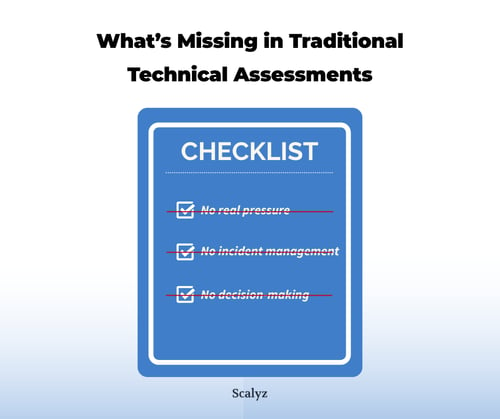
- lack of real-world pressure or urgency
- absence of incident management scenarios
- limited assessment of decision-making under stress
As a result, a candidate may pass a technical test successfully without being able to handle critical situations in a live production system.
To explore this topic further, you can also read our article “The Hidden Limitations of Traditional Technical Tests”, which highlights the often overlooked biases in standard engineering evaluation methods.
4. Key Skills of a Reliable IT Production Engineer
A reliable IT production engineer is defined by a combination of essential technical and behavioral skills that ensure system stability and operational excellence.
Technical skills
- IT incident management
- monitoring and alerting systems
- fast and effective troubleshooting
- strong DevOps environment knowledge
- understanding of distributed systems
Behavioral skills
- ability to perform under technical pressure
- fast and confident decision-making
- operational discipline and attention to detail
- clear communication during critical incidents
These skills are closely aligned with modern practices such as DevOps and the Site Reliability Engineer (SRE) role, which focus on building and maintaining highly reliable production systems.
5. The Importance of Real-World Scenarios in Evaluation
To effectively assess a reliable IT production engineer, real-world simulations are essential. They help replicate situations such as:
- a production system outage
- performance degradation issues
- critical service failures
Example scenario:
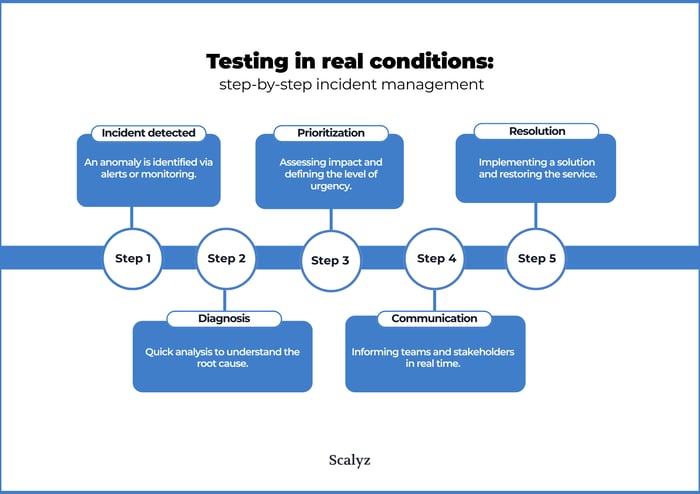
A database incident causes significant latency in a production application. A reliable engineer should be able to:
- quickly identify the root cause
- prioritize corrective actions
- communicate effectively with relevant teams
- restore service as fast as possible
It is in these high-pressure, real-world scenarios that true engineering reliability becomes visible.
6. How to Better Evaluate Reliability in IT Hiring
To improve IT hiring processes, it is essential to adopt evaluation methods that are closer to real production environments and operational conditions.
Best practices:
- use production-inspired scenarios and simulations
- observe the candidate’s problem-solving approach
- assess the use of monitoring and observability tools
- evaluate performance under technical stress
- standardize evaluation criteria across all candidates
These practices help hiring teams better identify engineers who can reliably operate in real-world production systems.
7. Towards More Realistic IT Engineer Evaluation
The most successful companies in IT hiring are those that adopt evaluation methods based on real-world scenarios rather than purely theoretical assessments.
By replicating real production conditions, you can:
- reduce hiring mistakes
- identify truly production-ready engineers
- improve the overall performance of your engineering teams
This shift toward practical, scenario-based evaluation leads to more accurate and reliable hiring decisions.
Conclusion
A reliable IT production engineer is far more than a technical expert. They ensure system stability, handle incidents effectively, and make critical decisions under pressure. As modern infrastructures become increasingly complex, the ability to identify these profiles has become a major competitive advantage for any organization.
Want to identify truly reliable IT production engineers? Discover how Scalyz helps you simulate real-world environments, assess technical skills in realistic conditions, and make more accurate and confident hiring decisions.
Partager cet article