Most teams look for a "hard" technical test. That's the wrong target. A hard test isn't a relevant test. What matters is a technical assessment suited to the role: a test that measures what the person will actually do once in the job.
The problem is that a generic test evaluates everyone the same way, whatever the role. Yet a DevOps engineer, a backend developer, and a cloud engineer don't mobilize the same skills, the same contexts, or the same ways of working. One test can't predict success for all of them. This article shows how to go from a job description to a genuinely relevant assessment, step by step.
Table of contents
1. Why a Generic Technical Test Isn't Enough2. Start From the Job's Missions
3. Turn Missions Into Observable Skills
4. Choose a Situation That Reflects the Role's Context
5. Define Criteria Before Launching the Assessment
6. Build a Consistent Path for Every Candidate
7. From the Job Description to the Assessment
FAQ
Conclusion
1. Why a Generic Technical Test Isn't Enough
A generic test rests on a false assumption: that technical skill would be the same from one role to the next. It isn't. Every role has its critical situations, its tools, its expected reflexes.
What a generic test misses:
- the role's real context, which changes everything
- the specific skills that set this role apart from others
- the way of working particular to the team and environment
The most common confusion is believing a hard test is a good test. A tough algorithm exercise can be very hard and completely off-topic for an operations role. Difficulty isn't relevance.
2. Start From the Job's Missions
It all starts with the job description, read differently: not as a list of technologies, but as a list of concrete missions. What will the person actually do day to day?
The typical missions of a tech role:
- diagnose incidents
- configure environments and services
- automate tasks and deployments
- solve problems in real conditions
What matters is identifying the three or four truly decisive missions — the ones that will fill most of the time and where failure is costly. Those are what the assessment must reflect, not the entirety of an ideal job description.
3. Turn Missions Into Observable Skills
A mission isn't yet an evaluation criterion. You have to translate it into observable skills — behaviors you can actually see during the test.
Don't list technologies; define what you want to observe:
- problem-solving when facing an unfamiliar situation
- diagnosis: reading the right signals before acting
- autonomy: moving forward, searching, unblocking oneself
- adaptability: integrating new information mid-task
"Knowing Docker" isn't observable. "Diagnosing why a container keeps restarting by reading the logs" is. It's exactly what engineering managers look for: skills in action, not a list of tools.
4. Choose a Situation That Reflects the Role's Context
Once the skills are defined, you need a support to observe them. A realistic situation always says more than a series of isolated technical questions.
Why the scenario beats the question:
- it places the skill in the real context where it's exercised
- it reveals the approach, not just the knowledge
- it can't be prepped like a stock question, so it can't be faked
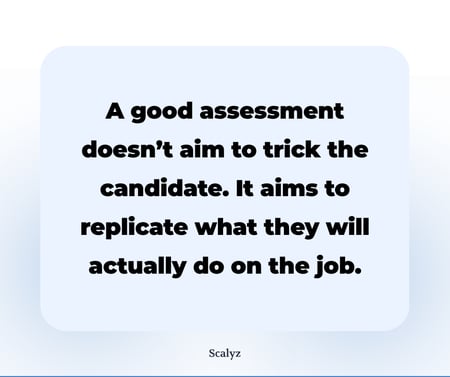
The goal isn't to trap the candidate, but to recreate a faithful sample of their future day-to-day. For an operations role, an incident to diagnose on a realistic infrastructure beats ten disconnected theory questions. The scenario should resemble the job, not an exam.
5. Define Criteria Before Launching the Assessment
Before the first candidate, decide what will distinguish a strong performance from a weak one. Without criteria defined upfront, you'll judge on gut feeling and unconsciously adjust them to your preferences.
What the criteria must enable:
- recognizing a strong performance by precise, observable signs
- comparing candidates on the same dimensions
- justifying the decision, internally and to the candidate
A good criterion describes a behavior, not an impression. "Validates their fix before applying it" is a criterion; "good technical level" isn't. These upfront criteria are what make results interpretable and comparable.
6. Build a Consistent Path for Every Candidate
A relevant assessment isn't enough if each candidate experiences it differently. A consistent path is what makes results truly usable.
The conditions for a consistent path:
- the same expectations and the same scenario for everyone
- the same criteria grid applied by all evaluators
- a structured flow, from scoping to decision
What matters is that a candidate's result depends on them, not on the conditions they were evaluated in or the person who judged them. A standardized path turns a series of isolated evaluations into a reliable basis for comparison.
7. From the Job Description to the Assessment
In practice, the whole challenge is connecting these steps without losing consistency: start from the role, derive the skills, translate them into a scenario, set the criteria, and give every candidate the same path.
That's exactly what campaign creation in Scalyz enables. With Scalyz, recruiters build their campaign from the role and the skills they're looking for, then invite their candidates into the same space and the same framework. The assessment flows directly from the role, and all candidates are evaluated on the same basis, making results immediately comparable.
The benefit is twofold: an assessment aligned with the role, and an identical path for everyone, with no manual standardization effort on each hire.
8. FAQ
Is a hard test a good test?
No. Difficulty isn't relevance. A good test recreates a faithful sample of the role's future day-to-day, not a tough but off-topic exercise.
How do you adapt an assessment to a specific role?
By starting from the role's real missions, translating them into observable skills, then building a scenario that reflects the work context. The job description is the starting point.
Do you need a different test for each role?
The criteria and scenario must reflect the role, yes. But the method stays the same: missions, observable skills, realistic situation, defined criteria, consistent path.
How do you keep results comparable across candidates?
By giving everyone the same scenario, with the same criteria grid and a structured flow. A consistent path is the condition for comparison.
Conclusion :
A technical assessment suited to the role isn't measured by its difficulty, but by its fidelity to reality. Start from the missions, translate them into observable skills, embody them in a representative situation, and set the criteria upfront: that path, from job description to assessment, is what produces relevant, comparable results.
The right question isn't "is my test hard enough?" but "does my test really resemble the role?"
Discover Scalyz and let's talk about your IT hiring needs.
Partager cet article :


